 Lodestar
 collateral determines borrowing headroom together with outstanding debt
Lodestar collateral consists of enabled deposits that back loans in Lodestar Finance's Arbitrum money market. Each asset's collateral factor determines how much of its assessed value counts toward borrowing capacity. Subtracting debt, including accrued interest, gives remaining headroom in the same value denomination. Supplying alone does not enable collateral. During a borrow check, the published implementation automatically includes eligible deposits in the borrowed market. Borrowing also requires permission under the selected market's controls and enough cash in that pool.
The collateral toggle and debt balance affect different records
An account can hold a supplied position without collateralizing it, enable eligible deposits to support borrowing, and maintain loans against their combined weighted value.
Enabling a supplied market
Lodestar's Security documentation bars people from OFAC-sanctioned nations from all its services. The documented dashboard places a collateral toggle alongside the supply position and requests confirmation of that setting. Enabling it allows the Comptroller, the contract that enforces account risk rules, to include the eligible deposit when valuing collateral. The setting does not itself transfer borrowed assets or create a loan balance.
Keeping debt separate from deposits
Borrowing creates an obligation in the selected underlying asset. The collateral can sit in another eligible market, so health depends on both sides of the account. A larger displayed supply balance does not establish how much debt that account can add.
How is remaining borrowing headroom calculated?
Remaining headroom equals factor-adjusted collateral value minus the value of all outstanding borrows, with interest included at the calculation's checkpoint.
Weight each enabled deposit
Let V_i represent the underlying value of an enabled deposit and f_i its collateral factor as a fraction. Total capacity is C = sum(V_i × f_i). Apply each market's own factor before summing. Using one asset's factor across the entire account would misstate capacity when those settings differ.
Include the whole debt value
Let D represent the total valued balance of every borrowed asset. Debt receives no collateral-factor discount. Headroom is H = C - D. Positive H expresses unused borrowing value; negative H expresses a collateral shortfall. C, D, and H must share consistent prices, units, and account state.
Convert headroom into an asset amount
To express positive headroom in units of the asset being borrowed, divide it by that asset's price in the same denomination. This converts account-level value into a token amount. The mathematical ceiling still excludes market cash constraints and leaves no allowance for subsequent interest or adverse price changes.
Headroom does not reserve cash in a borrowing market
Positive account headroom does not earmark tokens in the market that will supply the loan. That market must have sufficient underlying cash. Borrowing also requires a listed market, a usable oracle price, and an unpaused borrow function. A configured nonzero borrow cap rejects a request that would bring total market borrowing to or above the cap. Adding collateral cannot resolve every one of these separate restrictions.
A worked calculation with collateral initially disabled
A hypothetical account has one supplied position worth 8.7 ETH, a 60% collateral factor, no debt, and no other deposits. It seeks a loan worth 2.17 ETH from a different market. All balances, valuations, the factor, and assumed market availability in this example are illustrative. The deposit's collateral setting starts disabled.
With that setting off, the position contributes no borrowing capacity. Requesting the loan at this point would fail the collateral test. The missing prerequisite is activation of the supplied market as collateral.
Once the account enables that market, its weighted collateral value becomes 8.7 × 0.60 = 5.22 ETH. Assuming the borrowed market has sufficient cash and permits the request, the loan adds debt worth 2.17 ETH. Remaining headroom becomes 5.22 - 2.17 = 3.05 ETH.
After successful borrowing, the selected market records the new debt, and the enabled deposit still backs that obligation. At the example's unchanged valuation, with no additional accrued interest, health factor equals 5.22 ÷ 2.17, approximately 2.41. The 3.05 ETH headroom describes this account state; later prices, factors, or interest change the calculation.
Collateral factors can change without a token transfer
A collateral-factor change can alter borrowing capacity while the account's token balances remain unchanged. When the Comptroller applies a lower factor to the same supplied position, its contribution to borrowing capacity falls even if the account has moved no tokens, the oracle price has stayed constant, and debt has not changed. The factor belongs to a particular market deployment, so an old percentage attached to a familiar ticker does not establish the setting that a transaction will use.
A zero collateral factor contributes no borrowing value. An enabled setting cannot override it.
Health factor measures coverage while headroom measures value
Health factor expresses collateral coverage as a ratio, whereas headroom expresses the same relationship as an amount of value. For an account with debt, health factor equals total factor-adjusted collateral value divided by total debt value. Both values use the same denomination, with accrued borrowing interest included in debt.
A health factor of 1.0 means weighted collateral capacity matches debt. Below 1.0, the account has a shortfall that permits liquidation under the ordinary market rules. Borrowing interest can erode coverage even when prices remain unchanged. Subsequent price or risk-parameter changes can consume that margin. A shortfall measures the risk-weighted deficit; unweighted deposit value can still exceed debt.
Oracle valuations connect both sides of the account
Protocol oracle prices value collateral and debt in the liquidity calculation. Wallet quotes can differ from the value that the lending contract uses. Deposit representations called lTokens also have an exchange rate to their underlying assets. Their token count alone does not specify the underlying amount supporting debt. Falling collateral prices reduce capacity, while rising borrowed-asset prices increase the valued obligation.
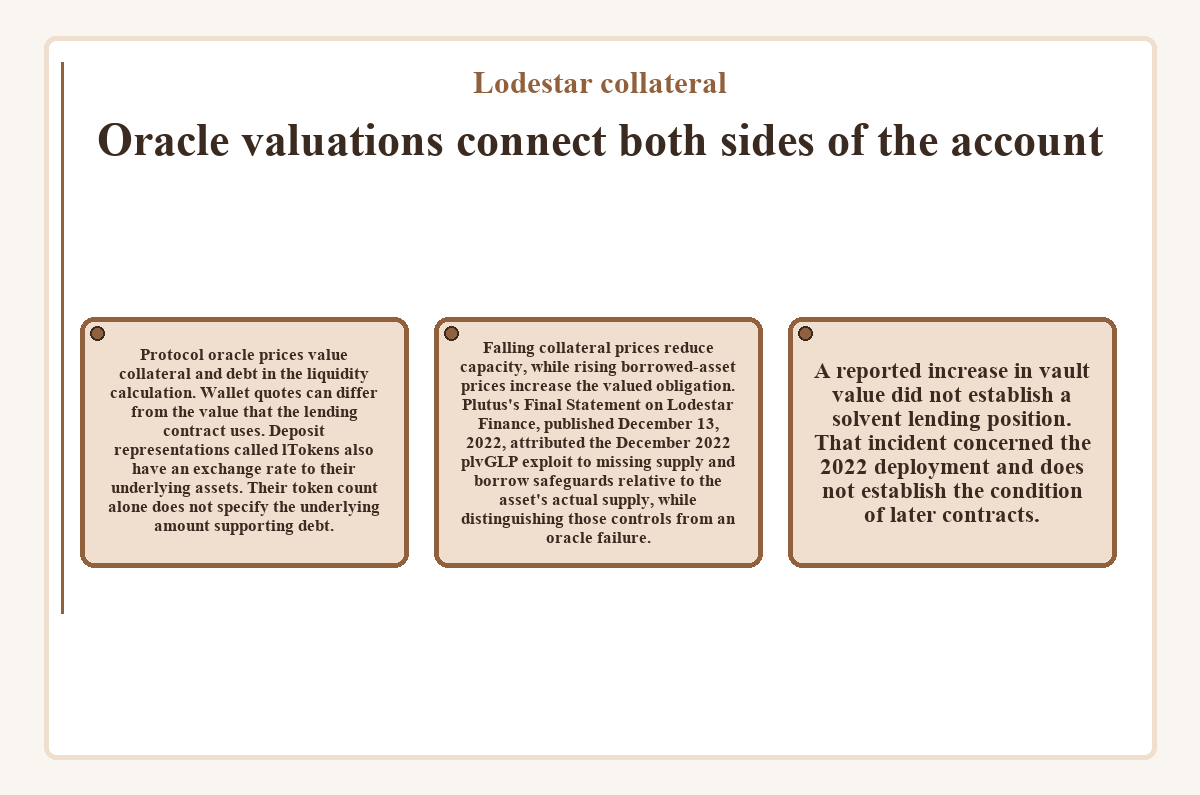
Plutus's Final Statement on Lodestar Finance, published December 13, 2022, attributed the December 2022 plvGLP exploit to missing supply and borrow safeguards relative to the asset's actual supply, while distinguishing those controls from an oracle failure. A reported increase in vault value did not establish a solvent lending position. That incident concerned the 2022 deployment and does not establish the condition of later contracts.
When can collateral be withdrawn or disabled?
A collateral reduction must preserve sufficient remaining debt coverage, while redemption additionally requires enough cash in the selected market to fund the withdrawal.
Redeeming part of a deposit
Redemption exchanges lTokens for underlying assets and reduces the supplied position. The Comptroller evaluates the resulting coverage when the market is enabled as collateral, so a withdrawal can fail even if the account holds enough lTokens, because the removed deposit value would leave other debt insufficiently backed.
Removing a market from collateral
The published exitMarket function requires no outstanding borrow balance in the market being exited. It also rejects removal when other debt still needs that market's collateral. Debt in another market can remain only if the remaining collateral covers it. Exiting market membership does not itself redeem the deposit.
Transferring lTokens to another address
An lToken transfer triggers a collateral-coverage check on the sending account when that account has entered the transferred token's market. The Comptroller applies its redemption-permission logic to the transferred quantity. A transfer that would leave that account undercollateralized can fail, even though ownership of the token ordinarily permits transfers.
Account readings include errors and stored balance checkpoints
The getAccountLiquidity method returns an error indicator, available account liquidity, and shortfall. After a successful calculation, liquidity represents excess weighted collateral value, while shortfall represents the deficit. Both can equal zero at the boundary. A nonzero error means the numerical fields do not establish a valid headroom assessment. Raw contract values also require their proper fixed-point scaling.
This view method reads stored market snapshots without refreshing every market's interest. Consequently, its answer can differ from a calculation after the lending contracts update their balances. Comparing readings requires matching the account, deployment, prices, and balance checkpoints. A stored headroom reading cannot establish the exact capacity that a later transaction will encounter.
Ordinary liquidation and deprecated markets use different conditions
Ordinary liquidation requires a collateral shortfall and limits the repayment through the configured close factor. That factor applies to debt in the borrowed market, not a fixed percentage of the account's original collateral. The collateral taken also depends on the repayment amount, relevant prices, liquidation incentive, and collateral-token exchange rate.
The published implementation defines a deprecated market through three simultaneous settings: a zero collateral factor, paused borrowing, and a 100% reserve factor. For debt in such a market, its liquidation branch bypasses the ordinary shortfall and close-factor checks. It permits repayment up to the full outstanding balance, subject to the remaining liquidation checks. A healthy-looking aggregate ratio therefore does not establish protection for deprecated-market debt.
Liquidation reduces debt and takes collateral. It need not clear every borrow that the account holds.
Yield-bearing collateral and looping add valuation dependencies
The exchange rate between an lToken and its underlying asset tracks the deposit claim. If that underlying asset is itself a yield-bearing derivative, its own value introduces another dependency before the collateral factor applies. Growth in a derivative's underlying holdings does not establish price stability, immediate redeemability, or sufficient cash in the lending market.
Looping increases supplied exposure alongside borrowed debt, so a higher supply total alone cannot establish improved coverage. Borrowing interest continues to affect the obligation while supply returns affect the asset side. The next loan or withdrawal amount must fit the resulting collateral coverage and the selected market's available liquidity.
Frequently asked questions about Lodestar collateral
Does unused Lodestar collateral capacity incur borrowing interest?
Unused collateral capacity creates no borrowing-interest charge because interest applies to outstanding debt, while the supplied assets continue to follow their market's supply-interest mechanism whether or not the account uses that capacity.
Will collateral in another wallet support this account's borrow?
A deposit under another wallet address does not contribute to this account's collateral calculation. The Comptroller values each account using its own market memberships and balances. Control of both wallets does not combine their collateral into one borrowing limit within the lending deployment.
What does collateralFactorMantissa mean in contract data?
collateralFactorMantissa stores the market's collateral factor as a fixed-point integer scaled by 10^18. Dividing by 10^18 gives the fraction used to weight collateral value. Token decimals and oracle-price scaling are separate, so raw balances cannot be multiplied as though every contract field used identical units.
Does enterMarkets enable every requested collateral market?
enterMarkets returns a separate result for each requested market address. Execution of the transaction alone does not establish that every entry succeeded. Its return array identifies individual outcomes, while checkMembership identifies whether a particular account has entered a particular market.
Why does an oracle error differ from a zero collateral factor?
An oracle error prevents a valid valuation, while a zero collateral factor assigns no borrowing value to the deposit. In the published Comptroller, a zero returned oracle price produces PRICE_ERROR. The resulting numerical fields must not be interpreted as a successful assessment of worthless collateral.
Can a supply cap reduce collateral already counted toward my loan?
A supply cap constrains additional deposits and does not replace the collateral factor in the valuation formula. Existing collateral contributes its assessed value multiplied by the applicable factor; outstanding debt reduces the remaining borrowing headroom. Lowering the supply cap alone does not remove a supply balance or repay the account's borrow.
Updated on